|
||||||||||
|
|
||||||||||
|
||||||||||
|
|
||||||||||
 - -
|
|
|
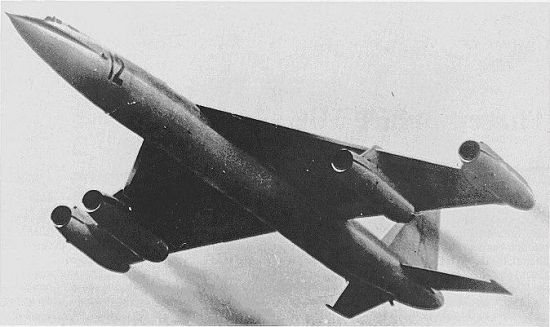
Myasishchev M-50, M-52 ASCC codename: Bounder Strategic Bomber Prototypes |
|
DESCRIPTION:
Though it never entered service, the Myasishchev M-50 was a highly advanced design for a large, supersonic intercontinental bomber. The M-50 was considered top secret by Soviet leadership and very little is known about the project even today. The Myasishchev design bureau began work on the M-50 concept in 1956. The M-50 was designed to carry the long-range M-61 cruise missile also under development by Myasishchev at the time. A key element of the M-50 design was its engines, originally intended to be advanced powerful turbojets built by Zubets. Development problems delayed these engines, so the first M-50 prototype was instead equiped with less powerful VD-7 turbojets mounted two beneath the wing and one at each tip of the large cropped-delta wing. The long-slender fuselage provided accomodation for two or three crew members and a large weapons bay. The fuselage also incoporated the area-rule to reduce transonic drag. The first M-50 prototype, with its substitute engine installation, served as a technology demonstrator and was capable of a maximum speed of Mach 0.99. The second prototype, redesignated the M-52, was equipped with the more advanced engines that doubled the maximum speed to Mach 1.83. Despite this progress, the M-52 program failed to impress Soviet leaders who had become convinced that manned bombers were obsolescent following the development of ballistic missiles. As a result, the M-50/M-52 project was cancelled and the Myasishchev design bureau closed in 1960. A surviving example of the impressive M-50 is now on display at the Monino Aviation Museum in Moscow.
Last modified 19 September 2009
|
|
| HISTORY: | |
| First Flight | 27 October 1959 |
|
Service Entry
|
did not enter service
|
| CREW: |
two or three
|
|
ESTIMATED COST:
|
unknown
|
| AIRFOIL SECTIONS: | |
| Wing Root | unknown |
|
Wing Tip
|
unknown
|
| DIMENSIONS: | |
| Length | 188.46 ft (57.48 m) |
| Wingspan | 82.29 ft (25.10 m) |
| Height | 27.05 ft (8.25 m) |
| Wing Area | 3,125 ft² (290.6 m²) |
|
Canard Area
|
not applicable
|
| WEIGHTS: | |
| Empty | 187,390 lb (85,000 kg) |
| Normal Takeoff | unknown |
| Max Takeoff | 462,970 lb (210,000 kg) |
| Fuel Capacity |
internal: unknown external: unknown |
|
Max Payload
|
44,090 lb (20,000 kg)
|
| PROPULSION: | |
| Powerplant | four Dobrynin VD-7B afterburning turbojets |
| Thrust |
83,700 lb (372.33 kN)
|
| PERFORMANCE: | |
| Max Level Speed |
at altitude: 1,215 mph (1,950 km/h), Mach 1.83 [M-52] at sea level: unknown cruise speed: 935 mph (1,500 km/h) |
| Initial Climb Rate | unknown |
| Service Ceiling | 54,100 ft (16,500 m) |
| Range | 3,995 nm (7,400 km) |
| g-Limits |
unknown
|
| ARMAMENT: | |
| Gun | none (?) |
| Stations | one internal weapons bay |
| Air-to-Surface Missile | designed to carry the M-61 cruise missile |
| Bomb | various nuclear and conventional bombs |
| Other |
none
|
| KNOWN VARIANTS: | |
| M-50 | First prototype used as a technology demonstrator |
| M-52 |
Second prototype equipped with more powerful engines and a new tailplane arrangement
|
|
KNOWN OPERATORS:
|
Union of Soviet Socialist Republics, Voyenno Vozdushniye Sili (Soviet Air Force)
|
|
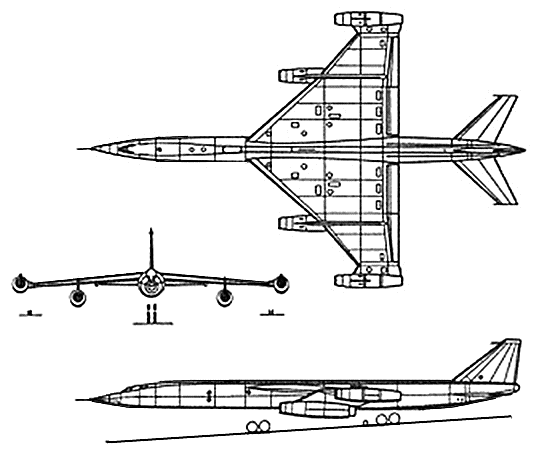
3-VIEW SCHEMATIC:
|
|
SOURCES:
|
|


|
Aircraft | Design | Ask Us | Shop | Search |

|
|
| About Us | Contact Us | Copyright © 1997- | |||
|
|
|||